Thursday, 15 March 2012

Winter of 1905

Prince Edward Islanders have seemingly escaped too much in the way of shovelling this winter, 2011/12, despite Old Man Winter's early start with a couple of dumpings in December.
The Guardian in 1905, however, records the challenges caused by snowfall for travel, communication and general state of mind. These short paragraphs complaining of snowfall amounts are found day after day throughout January, February and March, 1905.

Here's an account from mid February, concerning Egan's cutting (the section of railway dug out near Mount Stewart):
It is hard for any one who has not been over the Island railway during the past week or two to conceive of the great difficulty experienced in opening a way for trains. Many places for hundreds of yards the track is just a narrow passage the width of the snow plough cut through the snow, and this fills in with the slightest drift. The Guardian representative on Saturday had the privilege of seeing Egan's cutting, a few hundred yards to the east of Mount Stewart, which is pronounced the biggest on the eastern line. No one who has not been on the spot can fully realize the work necessary to make a way through the bank. At Loyalist the cutting extends some hundred yards and is almost all the way over the tops of the cars. The snow is packed hard and the engines soon stick thus making shovel work necessary and greatly increasing the labor from what it would be if the snow were light.
 Things were no better to the west of the city:

Last evening, W.S. Louson arrived in the city shortly after dark having partly walked and partly driven from Hunter River. Mr. Louson, who on Friday walked from Kensington to Bredalbane, on Saturday walked to Hunter River, where he managed to get a team to drive him to the city yesterday. He reports the road is very much drifted and heavy, those driving having to get out and walk parts of the way. Mr. Louson says that from the general opinion gathered from the section men and railway employees, under present conditions the train coming east, which is stuck near Emerald, will hardly reach the city before Thursday night.
 (note the spelling of Bredalbane!)
One couldn't get around by rail, but walking wasn't recommended in the completely whitened landscape, either:

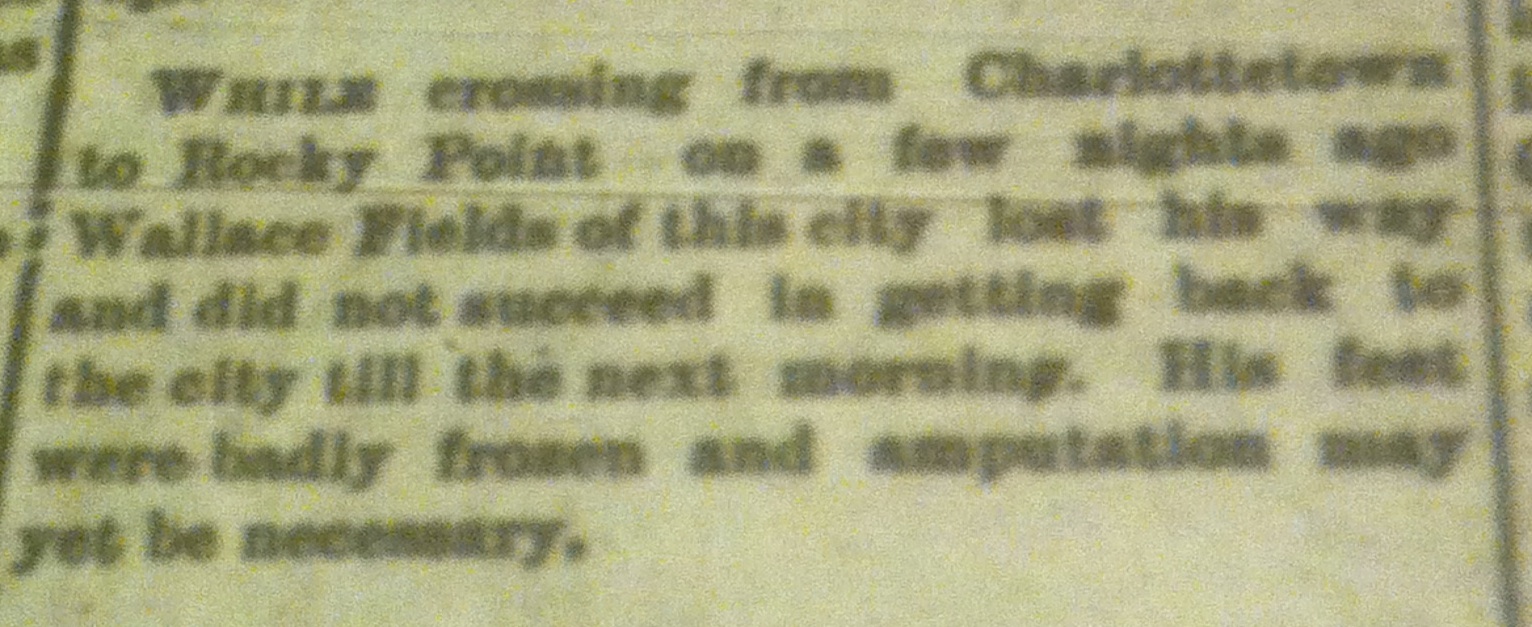
While crossing from Charlottetown to Rocky Point on a few nights ago Wallace Fields of this city lost his way and did not succeed in getting back to the city till the next morning. His feet were badly frozen and amputation may yet be necessary.

As has ever been the case, though, there is always some old grump who remembers having it worse!

A RESIDENT of Charlottetown calls attention to the fact that the storms of 1882 were even worse than the present year. At that time it took a week getting from Charlottetown to Summerside by rail and the banks around the city were even worse than the present time.

Thursday, 8 March 2012

Editor's Mail. April 12, 1899, The Morning Guardian

We were looking for an appropriate International Women's Day post for this blog when we came across this historical newspaper, loaded in the Islandnewspapers.ca online holdings.

This letter to the editor, appearing on Page 3 in the April 12, 1899, Morning Guardian, argues that intelligent, law-abiding women be given the vote and illiterate, criminal men have their electoral powers taken away.

It is not clear whether the author, G. A. Clay, is a man or woman, but he or she certainly has strong opinions about the franchise issue and -- as was almost always the case when the topic of giving women the vote arose -- temperance.


 The full text reads:


Editor's Mail: April 12, 1899, The Morning Guardian:

Men and Women.
Sir, — In contemplating the respective worth of men and women, and their value to society and civilization, the average person has always been ready to ascribe all honor and praise to the men, for their heroic deeds on the field of battle, for their persuasive eloquence by which they sway the multitude, and for their inventive genius by which they have, over and over again, revolutionized the different methods of production.
Women have been known to display marvelous feats of courage, and when their duty lay in the path of danger they are not inclined to shrink. In this connection I may be permitted to speak of Deborah, who urged a timid halting Barak to battle and went with him to successful war; of Esther who by one heroic act which involved the risk of her own life saved her nation from destruction; of Grace Darling who is still the heroine of a true story of rescue on the stormy coast of England; of Joan of Arc, who girded the French troops, repulsed the legions of Bedford and carried succor to a straitened garrison; and of Charlotte Corday who seemed the embodiment of courage in the grim tragedy which ended the life of Marat. Many other citations might be given. Still greater proof of women's courage and fidelity is to be seen on the broad mission fields wither she has gone, and is still going, to spread the light of truth and love among the benighted sons of men; and the fact that women have not participated in the great wars of the world, is a strong factor in her favor. War is a sphere which men have created for themselves.
Let us not fail to reflect on what women have achieved in the literary world. Does not "Uncle Tom's Cabin" stand unexcelled by any book of its kind? And did it not appeal to the common people, and thus shape the national character on the question of human slavery as no other power would do? And does not the name of its author and the names of Harriet Martineau, George Eliot, Charlotte Bronte, the Cary sisters and Mrs. Hemans, and many other female writers deserve to rank with almost any others that might be named? And yet it is claimed that women are unfit for the full privileges of citizenship; and claimed by those who enjoy those peculiar rights by reason of an accidental condition which even in their own sex is often unaccompanied by any special adornments apart from ignorance, bigotry, and greed. The writer is not in favor of universal women suffrage; that would be no improvement on present conditions. But the ideal system of franchise would appear to be one which would make the qualifications, not wealth or sex, but loyalty to existing law, and a certain standard of intelligence.
We boast of having extended the franchise: But it is not possible that by extending it to the hopelessly ignorant man, it has been extended too far? And by denying to the intelligent woman it has been too much limited? Here is a woman who feels a deep interest in the commonwealth, and has a good mental grasp of what the word "government" implies, and a fair knowledge of current events, and is capable of choosing between conflicting issues; and she is lawabiding, loyal to the laws in the making of which she has no voice. The other side of the picture is the officials in the polling booth helping Jim Blank mark his ballot. Jim can neither read, write, nor think intelligently. He has been twice fined for misdemeanor, and served two terms in the county jail. He knows nothing of the issues before the people, nothing about politics, in fact, in knowledge he is true to his name, he is a blank. And now the election official is helping him mark his ballot for the man who, during the campaign, bought his vote for a debauch on bad whiskey. It has frequently been urged that women are not constituted by nature for the great work of making laws. This we shall not attempt to deny. But shall be content to let history show, as it clearly does, that the slowness with which the councils of men have yielded to the claims of justice and the right, only proves them, above all things, to be endowed by nature with power or to hold tenaciously to every form of ancient barbarism. And when we look at present conditions, to say nothing of the past, and see over five hundred thousand saloons existing under the protection of men-made laws, in this North America, pouring forth their black streams for the creation of criminals, and then see the gallows, prepared by the same laws, for the criminals thus created, we must confess we are not over burdened with a sense of adoration. How have our Canadian rulers been dealing with this momentous question? By vacillation, by cowardice, by burking and shelving the question, by useless commissions of inquiry, by meaningless plebiscites, by laxity in the enforcement of existing laws. In all these ways they have shown a despicable subservience to the rum power, and have forfeited every claim to be votes of a Christian people. It is difficult to imagine a council of women who could so completely mock and delude a long-suffering nation. Intemperance is one great national sin; and by its debasing effects on the individual, it tends to destroy the national life, overthrow the church and shroud the world in ignorance and vice. Our hope of rescuing our country from the grasp of this foe, rests in our willingness to invest with legislative power those who will dare antagonize it. To this end let us have a cleaner and more intelligent electorate. Let us enfranchise all loyal and enlightened citizens irrespective of sex; and to disfranchise all who are known to be corrupt or illiterate, or who ruthlessly violate our country's law. Then with woman (who according to your recently published penitentiary statistics have so far exceeded the other sex in the matter of self control) exalted to her rightful place in the family of man, she can work side by side with the best men for the ushering in of the "good time coming, when right and might shall be the lord," and when the glorious destiny of which we dream shall be a grand reality.
Yours, very sincerely,
G. A. Clay

Wednesday, 1 February 2012

Pair charged with murder of Peter J. Trainor


Peter J. Trainor, 79-year-old Charlottetown storekeeper, met with an untimely death Jan. 30, 1941. On Feb. 1, Earl Lund and Frederick Phillips, both of Charlottetown and approximately 28 years old, were formally charged with murder.  


CAPTION: He was well and favorably known in the city and his passing will be mourned by many. The deceased has operated his store on the corner of Pownal and King Streets for many years and was highly regarded by all who knew him.


The body was found by a pair of police constables, "patrolling that section of the town in plain clothes and around midnight their vigilance was rewarded." The officers saw a man go past the store, which aroused their suspicion. Then they noticed a light in an upstairs window of Trainor's residence and then another come on in the store, which they knew to be shut at 10 p.m. They looked through a window and saw a man and heard a voice say, "The old son of a ___." 


"Almost immediately the policemen heard the bell of a cash register ring and the sound of silver rattling... Just then a man happened along and he was told to go to Joey MacDonald's house and telephone the Police Station for more officers."
Soon the officers surrounded the grocer's and a couple went inside, where they found Lund and Phillips upstairs in the building, each with a bottle of gingerale.
"It appears that Earl Lund made for a bed room window and dove right through it carrying sash and glass with him. He landed in the snow bank 14 feet below where he was welcomed by Constable Poole."
"Earl Lund, when the handcuffs were put on him, said: 'You got me.'" 

CAPTION: A view of the corner grocery store in which the tragedy took place. For many years the deceased, Peter J. Trainor, cheerfully served his many customers from the stock therein. Police saw a light shining from the large window and started their investigation. The lower right of glass next to the door was broken affording an entrance for the police who found the door locked.
Meanwhile, Phillips was still upstairs in the house and smashed his bottle of gingerale over the head of a policeman coming up the stairs after him, dazing the officer. His colleagues came to his assistance.

"...the man upstairs shouted, "Come and get me." Shouting back, "We're coming," the police started up after their man."
Phillips then flung a chair and an iron bar at the next two officers, striking one on the arm.


"However, they rushed the man at the top and after a struggle placed the handcuffs on him."

Phillips and Lund were formally charged two days later, convicted in June and hanged in August.

Theirs was last state execution on P.E.I.

Tuesday, 10 January 2012

Prime Minister of Prince Edward Island dies


On January 10, 1936, Prince Edward Island's first premier, Walter Lea, of Victoria, dies.
The Charlottetown Guardian story reads:
The Province suffered the loss of its Prime Minister, Secretary-Treasurer and Minister of Agriculture in the person of the Hon. W.M. Lea.
His death occurred at the Prince Edward Island Hospital, following a severe cold contracted the Saturday before, which developed into pneumonia. The Premier's condition had improved by Thursday but by late Thursday evening, his condition became so serious that his family was at once sent for and were brought by plane to his bedside. 

Lea, P.E.I.'s first premier, was the first political leader in British history to head a party which won every seat in parliament, completely routing the opposing forces. His death necessitated the resignation of this successful government.

Thursday, 5 January 2012

Power will be restored to all customers ... in six months


Widespread disruption of communication and power services, on a scale unprecedented in recent times, has resulted in Prince Edward Island as a result of the sleet storm which began Thursday, Jan. 5, 1956, and continued throughout Saturday. 
Maritime Electric Company estimated 2,000 poles came down under the weight of the ice, especially Summerside and west, which was declared a disaster area.  


Caption: WATER STREET JUST BEFORE THE WIRES CAME DOWN. A part of Summerside's business area is seen Friday afternoon as freezing rain continued to add heavy weight to electrical and communication lines and eventually brought them crashing to the street on Saturday morning. Practically every pole and line along the entire Water Street area was demolished. Similar damage occurred in almost every other section of Summerside, the R.C.A.F. Station, and in most districts in Prince County. (Photo by D.W. Sears)


Caption: PLENTY OF WINTER ON WINTER STREET. Two Guardian newsboys in Summerside, Jackie Gallant (left) and Michael Scott (center) accompanied by Hazen Mellish (right) are seen on the corner of Winter and Summer Streets where plenty of winter was indicated during the damaging weekend storm at Summerside. The electric light pole on which the "Winter St." sign is seen was among hundreds that came crashing to the ground. (Photo by D.W. Sears)
It will take six months before power is restored to all areas, especially rural Prince County. 
 

Tuesday, 3 January 2012

Liquidation sale, everything must go! No, really

On January 3, 1913, The Island Guardian runs a front-page ad in which HH Brown assures customers he really is closing up shop and clearing out his stock, refuting widespread rumours that somehow spread before the age of blogs, Facebook and Twitter!


The ad reads,
A word with You
It has been hinted that I do not intend to leave the Province. The only answer I can give to those who appear very anxious to see me leave is that as soon as I get all my goods sold my bills all paid and my belongings stowed away in a car, I will leave for Medicine Hat, Alberta.
The actual date will be near February 15th.
Really and honestly I thought that a young growing business like mine would have been picked up three months ago and that I would have been away before this. If I have to stay in the store during January I warn you to look out for bargains.
The balance of the stock will be cleared out at 15, 20 and 25 c on the dollar — below what I paid for it. I cannot afford to pay for much newspaper space and sell at those prices so I will only quote a few items here — this ad will only run a short time.
HH Brown

Also in the Jan. 3, 1913 edition, The Central Guardian clerks complain people continually call one department at the newspaper looking for the number of another "though all the numbers for the respective departments are plainly given in the telephone book."
The newspaper asks the public to stop calling the newsroom when they have an ad inquiry; the circulation desk when they have a news tip and the advertising department when they want to report a missing paper.
"It is a great waste of the time on the part of the person phoning, the operator at the Central and the department wrongly phoned. Patrons who consult their phone books for the numbers they really want will greatly lessen the work of the patient Central telephones and Guardian clerks and thus help make their lives much brighter and happier."

(In that vein, we might mention that if readers are looking for the address or phone number of any of our present-day Guardian staff, they would make our lives brighter and happier if they were to consult: http://www.theguardian.pe.ca/Our-Team . Thank you in advance and Happy New Year!)

Friday, 30 December 2011

Still covering Prince Edward Island like the dew

By Gary MacDougall
Managing Editor
The Guardian

Before Island soldiers marched off to fight in the Boer War at the turn of the 20th century, The Guardian was here.
It was the same a decade and a half later when a much greater number of innocent young Islanders set off for the First World War. The Guardian was here.
Long before the world marvelled at news the Wright brothers had conquered the skies in 1903, or that the Titanic had met tragedy on its maiden voyage in 1912, the Guardian was here.
The Guardian, in one form or another, has been published on Prince Edward Island since 1887, which means the newspaper is celebrating its 125th anniversary in 2012.
First edition of The Island Guardian

“In this day and age of multiple media platforms, and rapidly changing technology, we think it is quite an achievement to reach a landmark anniversary like 125 years and we are very proud of that fact,” says publisher Don Brander.
He is one of a number people who have guided the fortunes of the newspaper since it was created by Rev. W. R. Frame and Joseph W. Mitchell. Frame was the editor and Mitchell was the manager.
Brander says no doubt Frame and Mitchell had high hopes for their enterprise, but it’s doubtful they thought their newspaper would still be publishing 125 years later.
The newspaper began as a weekly and went by the name ‘The Island Guardian’. That paper was succeeded by the Daily Guardian in 1890. 
Through the decades there have been other variations on the name, such as Morning Guardian, Charlottetown Guardian and Guardian of the Gulf. There have also been a number of newspaper locations in the capital city, each new one built after the previous one burned, not an uncommon occurrence in the old Charlottetown dominated by wooden structures.
But regardless of the name, the one constant is that a Guardian has been published and loyally read by residents of the province for the past 125 years.
It’s not that The Guardian was the first paper in the province by any means.
A hundred years before The Guardian came into existence, indeed back when the Island was still a colony, The Royal American Gazette and Weekly Intelligencer of Saint John was published in 1787. The paper existed for less than two years but it kicked off the colourful history of the newspaper industry on P.E.I. Over 100 different titles have been published on the Island since then.
Harry Holman, a former provincial archivist, says The Guardian has always played an important role in P.E.I.
“For me, The Guardian has been for 125 years the record of our province,” said Holman. “And as our province has evolved and changed, The Guardian has evolved and changed.”
Copies of a 2011 edition of The Guardian run along the gripper.
There was a time when The Guardian, like most newspapers of the day, was fierecely partisan and reflected the interests and biases of its owners. Almost every major event of the day was interpreted through a particular political lens and many newspapers were just mouthpieces of political parties or institutions.
“There was a time when people only read newspapers that agreed with them,” said Holman.
He says times have changed and so has The Guardian in terms of impartiality. As an example, he cited the election of 1935 that saw the Liberals win 30 seats and the Conservatives none. The headline in the next day’s Guardian read: ‘Island Votes For Liberal Dictatorship’.
“As The Guardian has played more of a neutral role, it has actually become more important in shaping public opinion. Because no longer is the newspaper only a vehicle for seeing opinion that you agreed with, or facts interpreted in a way that you agreed with.”
Another long-time reader of The Guardian is Island historian Catherine Hennessey.
“Although I am an ardent daily reader of The Guardian, I have to say that it is my reading of the old newspapers that has had the greater impact on my life,” she said this week.
“For someone who has spent hours and hours reading the old newspapers — a year at a time — I can truly say that there is no more enriching way to capture an impression of our history than that day-by-day review,” she said.
While one of the benefits of a newspaper is that it provides clear hindsight on issues, the industry is certainly not standing still, nor can it afford to, says Brander. He said it must look ahead rather than backwards.
Advances in technology allow today’s newspapers to expand into areas few people could even dream of a few years ago, such as providing news and information throughout the day on the Internet, or via smart phones and other digital devices.
The new technology also expands the services a newspaper can offer its advertising customers, Brander said.
@PEIGuardian on Twitter

Like every newspaper, he said, The Guardian’s future depends on it being able to maintain its traditional base and also reach out and embrace the future.
“It’s a challenge but it’s an exciting challenge,” he said.
Beginning with the first newspaper of the year on Tuesday, Jan. 3, The Guardian will be running daily lookbacks on P.E.I. events, both important and trivial, that have been recorded in our pages during the past 125 years. A more indepth series of articles examining historical events will run throughout the year on our Opinon page.
In addition, a special 125th commemorative edition of the newspaper will be published in the fall of the year. Other special events are being planned and will be revealed as the year progresses.
It is hoped that some of the newspaper’s colourful history will be brought back to life during the anniversary year, as well as much of the province’s history, such as the time The Guardian took to dropping newspapers from the sky to answer a transportation challenge in Prince County in the 1940s.
The newspaper is also extending an invitation to readers to send in their recollections of events and happenings involving The Guardian, which we will then share with other Islanders.
When many people think of The Guardian they think of the motto on the front page, which says, “Covers Prince Edward Island like the dew.”
Holman, who is the director of culture,  heritage and libraries with the P.E.I. Department of Tourism and Culture, is fond of that motto but says he was always quite fond of a Latin quotation The Guardian once carried on its masthead which translated as “The strongest sword is weaker than the weakest ink.”
He thinks it’s a very appropriate one for a newspaper.
Frame and Mitchell didn’t use the quotation when they launched their newspaper in 1887, but no doubt it was a motto they would have agreed with. It would have been appropriate then, just as it is now.

Much of the early information about The Guardian and other P.E.I. newspapers comes from a document produced by Heather Boylan for the Public Archives of Prince Edward Island. It is entitled Checklist and Historical Directory of Prince Edward Island Newspapers 1787-1986.